Finnish law proposed from 1 Jan 2027 · HE 129/2026

Even pay. On time.

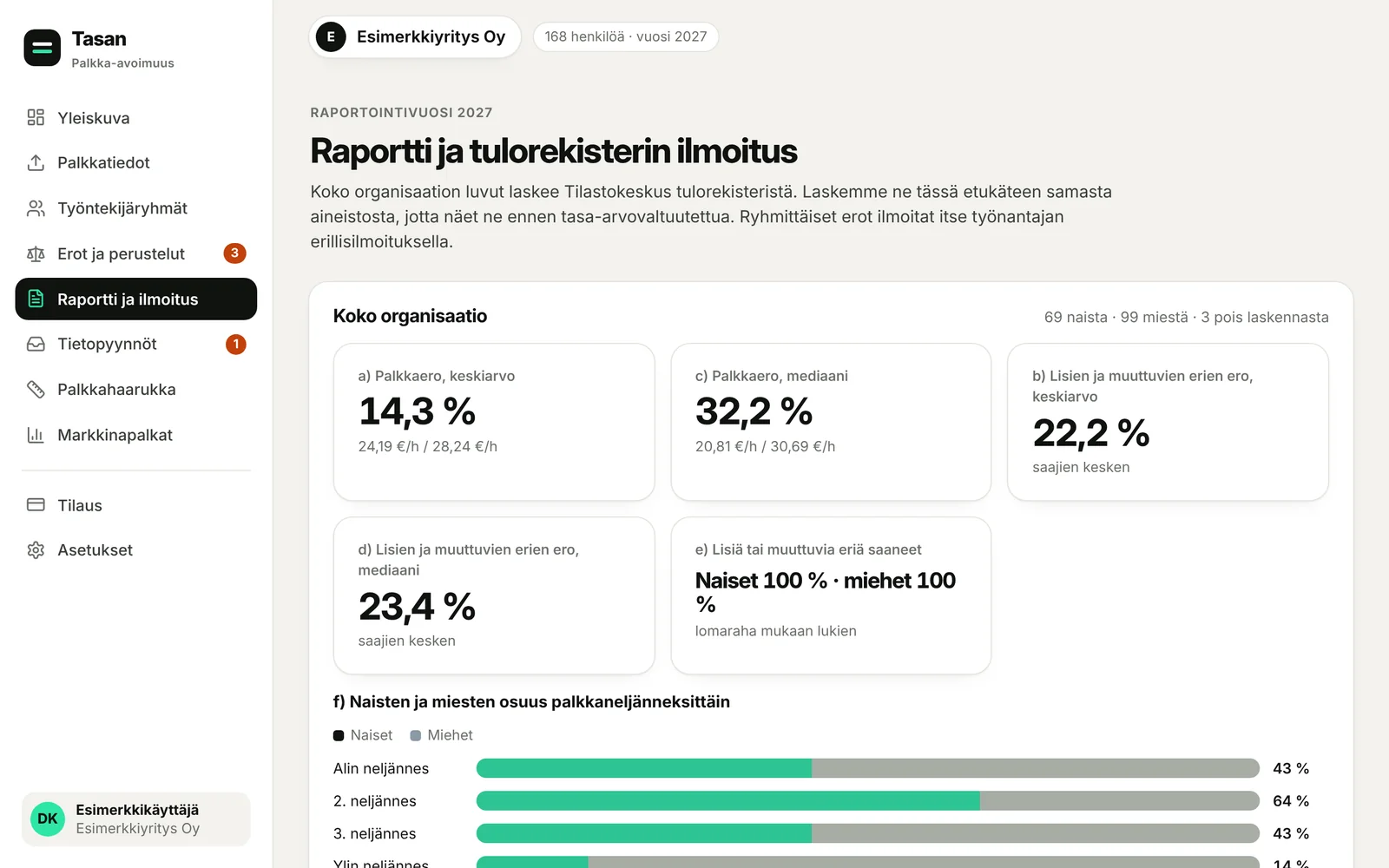
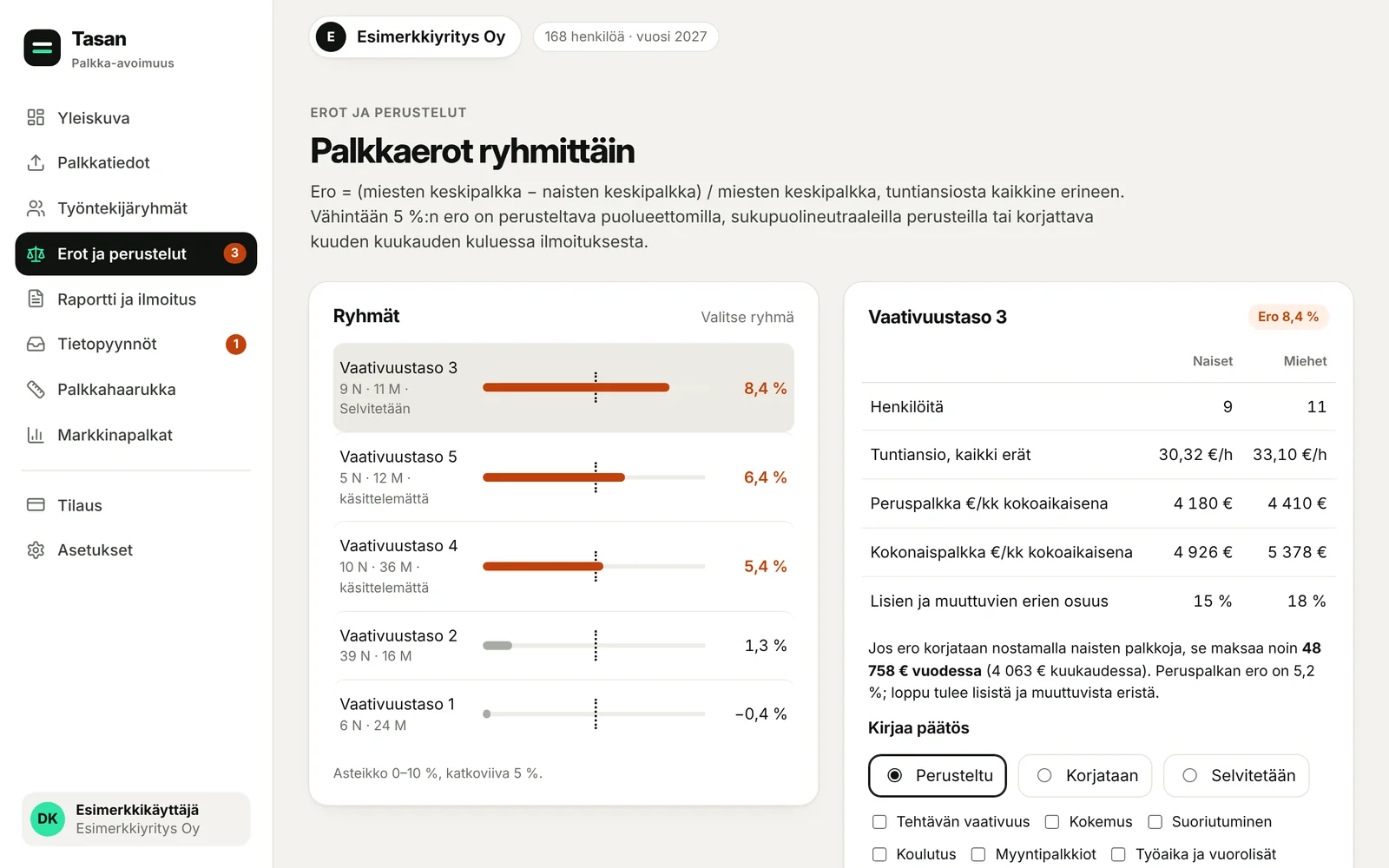
Tasan calculates pay gaps by employee group, collects the justifications and prepares the Incomes Register report and the replies to information requests. Built on Finnish law and Tax Administration guidance.

Law in force 1 Jan 2027Pay ranges and information requests for all employers
–days –hours –min –sec
Overview

The whole picture at a glance.

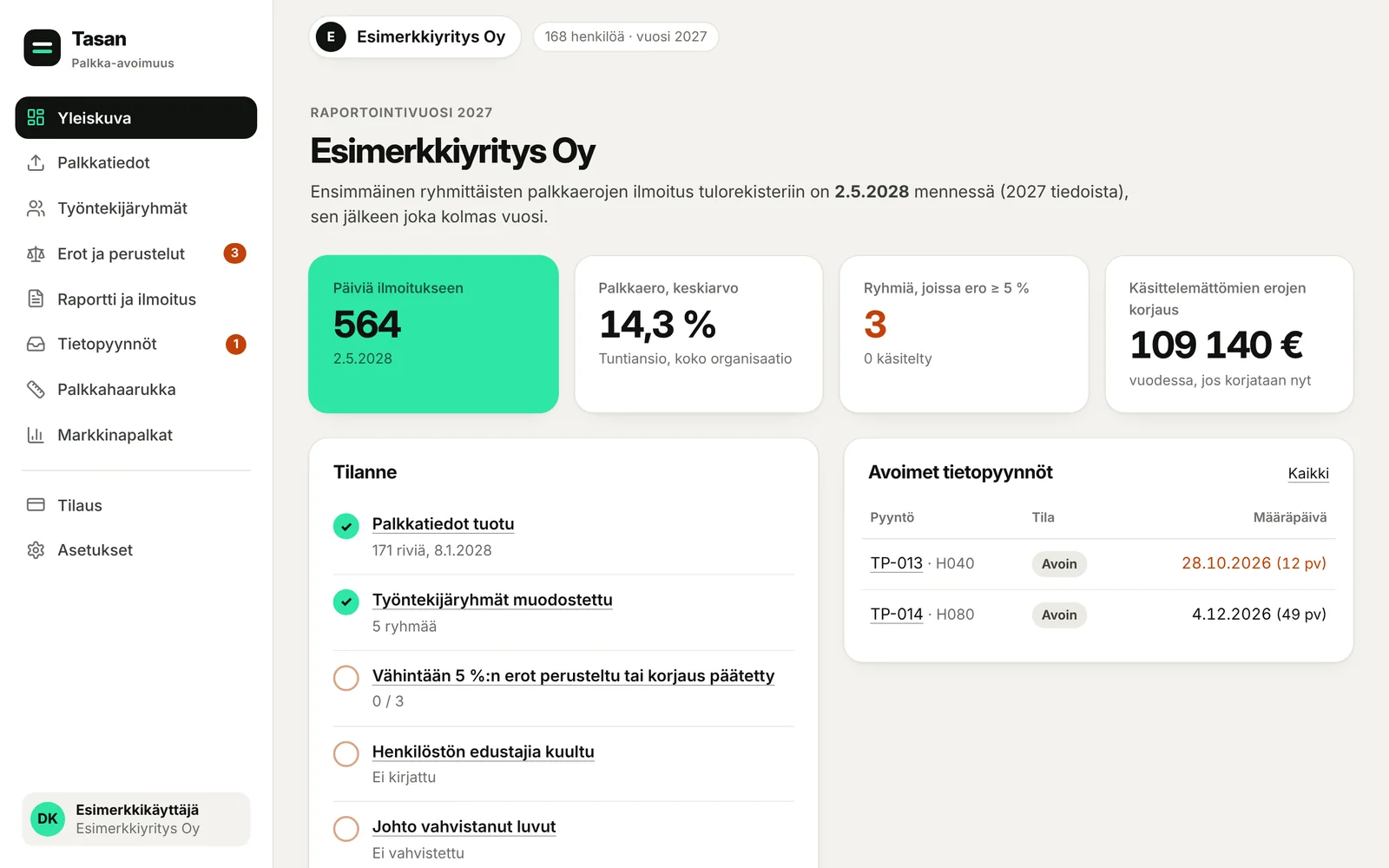
Deadlines, the pay gap, open gaps and what fixing them costs. A checklist shows what is done and what is still missing.

Open the demo company
Tasan overview: days to the report, pay gap, groups with a gap of 5% or more and the cost of fixing them (in Finnish)

Bring in pay data from where it already is

Try it now

Drop a payroll file. See the gaps.

Excel or CSV with employee number, gender, role and pay. The file is processed in your browser and never leaves your computer. No account needed.

  • Common Finnish and English column headings are recognised
  • Personal identity codes are only used to derive gender
  • See gaps, groups and the cost of fixing them straight away

The app is in Finnish for now. No file at hand? Open the demo company

How it works

Four steps. Done before the deadline.

  1. 1

    Bring in pay data

    Excel, CSV or the earnings payment reports from the Incomes Register. Personio and HiBob with API credentials.

    171 rows imported
  2. 2

    Form groups

    By collective agreement classification or a job evaluation on four criteria: skills, effort, responsibility and working conditions.

    5 groups
  3. 3

    Justify gaps

    For gaps of 5% or more you record a reason or a fix. You see the cost before you decide.

    3 groups over the limit
  4. 4

    Approve and file

    Management confirms the figures. The Incomes Register report and the staff report are ready.

    Report.xml
What mistakes cost

An unexplained gap gets expensive.

Penalty fee

if the joint pay assessment is not carried out. The amount is set when the law is passed.

€4,360

minimum compensation per person for pay discrimination. The time limit for claims grows to three years.

Burden of proof

If the employer has neglected its obligations, it has to prove there was no discrimination.

Timeline

Does this apply to you?

  1. 1 Jan 2027Pay range for applicants and information requestsAll employers
  2. 1 Jan 2027Working-time data in the earnings payment report150+ employees · 100–149: 2030
  3. 2 May 2028First pay gap report to the Incomes Register150+ employees · 250+ yearly, others every three years
  4. 2 May 2031First pay gap report to the Incomes Register100–149 employees

With 150–249 employees, you report pay gaps by employee group by 2 May 2028 and every three years after that.

Who it is for

One view for the whole organisation.

HR

Imports, groups and information requests in one place. Deadlines show on the overview.

Finance

The monthly and yearly cost of a fix before you decide. Pay corrections into the budget in time.

Management

Risks and deadlines at a glance. You confirm the figures before filing, and the confirmation is logged.

Employee representatives

Dated justifications and the staff report, ready for consultation.

Security and privacy

Pay data is sensitive. It stays in the EU.

  • Data in the EUThe database is in Stockholm.
  • No names or identity codesPersonal identity codes are only used in the browser to derive gender.
  • Row-level accessEveryone sees only their own organisation's data.
  • No passwordsSign in with a one-time link sent by email.
  • Audit logImports, justifications and confirmations are logged with who and when.
  • Follows the lawHE 129/2026 and the Tax Administration's schema. We update when the law is passed.
Questions

Frequently asked

Statistics Finland already calculates pay gaps. Do we need to do anything?

Yes. Statistics Finland only reports company-level figures. Employee groups, the gaps within them, justifications, information requests and pay ranges are the employer's responsibility.

Does this apply to companies with fewer than 100 employees?

Partly. Pay ranges for applicants, the ban on asking about pay history and information requests apply to every employer. Pay gap reporting applies to employers with at least 100 employees.

Do you need names or personal identity codes?

No. An employee number, gender, role, working time and pay are enough. If your file contains personal identity codes, we use them only in your browser to derive gender and never store them.

Is the service available in English?

This page is. The demo and the service are in Finnish for now, and the English version is in progress.

When can we start?

We are opening the service in stages. Join the waitlist at the bottom of this page and we will tell you first when you can start. You can try it with your own data now without an account.

What if Parliament changes the law?

Dates and calculations follow government proposal HE 129/2026 and the Finnish Tax Administration's guidance. We update the service once the law is passed.

What about other EU countries?

Every EU country has to bring the Pay Transparency Directive into national law. We start with Finland.
Opening in stages

Join the waitlist.

We are opening the service to companies in stages. People on the waitlist hear first when they can start. You can try it with your own data now.

Try with your own data →
Which systems do you use?

We build direct connections to the systems people on the waitlist use.

Payroll
HR system

We only use these details to contact you when the service opens. Privacy notice